Showing posts with label Jane Austen. Show all posts

Friday, September 13, 2013

Postcard From The Peak District: Austen, Bronte, The Plague, and Mr. Darcy


"We shall not be like other travelers, without being able to give one accurate idea of anything. We WILL know where we have gone--we WILL recollect what we have seen. Lakes, mountains, and rivers shall not be jumbled together in our imaginations"~Elizabeth Bennet

I first read about the Peaks District when it played a pivotal role in the plot of Pride and Prejudice: Elizabeth journeys to Derbyshire on a holiday with her aunt and uncle because the lakes were too far. As she says before their trip "What are young men to mountains?" Of course, it is also home to Mr. Darcy and, well, we all know how that worked out. 


But I became more aware of the area's outstanding natural beauty while watching one of the many television shows or films shot there.  The Peak District seems to have embraced it's association with televised costume dramas--but it's worth pointing out that before the location scouts came, the area served as inspiration for settings in both Jane Austen and Charlotte Bronte's most beloved works.


Some places let you down, like Epcot center or your local harvest fair. (Every fall I get duped into thinking fairs are cute and quaint but then when I go it's full of packs of rural teenagers huddled together gorging on cotton candy and wearing far too much eyeliner.) But, unlike Walt Disney's vision of the future or the Big E's cream puffs, England's Peak District surpasses your expectations. You can spend the whole time wondering if you've actually wandered onto a movie set. Pop in your headphones and play the soundtrack to Pride and Prejudice and you could be the star of your own film. Not that I would know anything about that...  


I stayed at a youth hostel in the tiny village of Eyam, also known as 'the plague village', because if you're me, you want to be as close to a historical bubonic plague site as possible. 


It looks like the quintessential English village--something you might come across in an Agatha Christie novel. Except instead of a disgruntled school marm or vengeful stable boy, the bubonic plague was doing most of the killing. 


The only thing scarier than the bubonic plague being delivered to your doorstep are awkwardly posed mannequins in bad wigs.


The downside to staying in Eyam was that when I had to actually get around the area I was at the mercy of the local bus system. I had prepared for this by spending far too much time on a TripAdvisor forum solely dedicated to the purpose of helping visitors without cars manage public transportation. I don't want to say it is impossible, because clearly I managed. But if you do go, I strongly suggest driving unless you like the idea of carrying your luggage up deceptively steep hills or returning to your hostel by 3 pm each afternoon. 


This photo is on an incline because I was on an incline. Also, llamas!


In Pride and Prejudice, the nearby (but poorly bus serviced) town of Bakewell fills in for Lambton--very pleasant, rather touristy and the namesake for Bakewell puddings and tarts. 


Though much like NYC's Original Ray's pizza there is much debate over which establishment was the first to offer it. My money is on The Old Original Bakewell Pudding Shop, mostly because it was the best one I had. 


A short (and frequent) bus ride away is Chatsworth, the grand estate of the Duke of Devonshire, and inspiration for Pemberley, the ancestral home of the Darcys. 


"It was a large, handsome stone building, standing well on rising ground, and backed by a ridge of high woody hills…"

In the 1995 miniseries starring little known actor Colin Firth, Lyme Park in Disley, a couple hours northwest of where I was,  served as Pemberly. But in the 2006 film version, Chatsworth takes on the part it was born to play. Perhaps it isn't surprising then that about a quarter of Chatsworth's giftshop is devoted exclusively to Mr. Darcy.This includes a greeting card featuring an illustration of Colin Firth making this face:


I actually felt embarrassed for a moment because such a thing actually exists for people to buy. I prefer this face instead:


"Dearest, loveliest Emily. You must allow me to tell you how ardently I admire the new Monsoon dress I bought for you."


"Yes, of course we can sit on the couch and watch the entirety of the television program Parks and Recreation. I too enjoy Ron Swanson's moustache and Andy's silly antics."


"Is it really necessary for me to walk around in this wetted shirt all afternoon? It is? Very well."

But, if I'm completely honest with myself, I probably would have bought the card if no one had been around and if the cash register was instead manned by a fancy robot with a British accent--think C3-PO in a powdered wig. I mean, who am I to judge? I had just spent the entire tour pretending to be Elizabeth Bennet during her inaugural visit to Pemberley. 


It was a bit difficult, what with the mob of tourists around, but if I closed my eyes and tried to ignore the swarms of old Germans on either side (it's always Germans), I could, for a very brief moment, hear Darcy calling to me from the boudoir. And, in that instance, he was definitely making this face:


After visiting Chatsworth I decided to check out Haddon Hall, a Tudor manor that was supposed to contrast nicely with the Georgian elegance of the former. And, like Chatsworth, it also has it's fair share of movie credits: The Princess Bride, Elizabeth, Jane Eyre, etc, etc. 
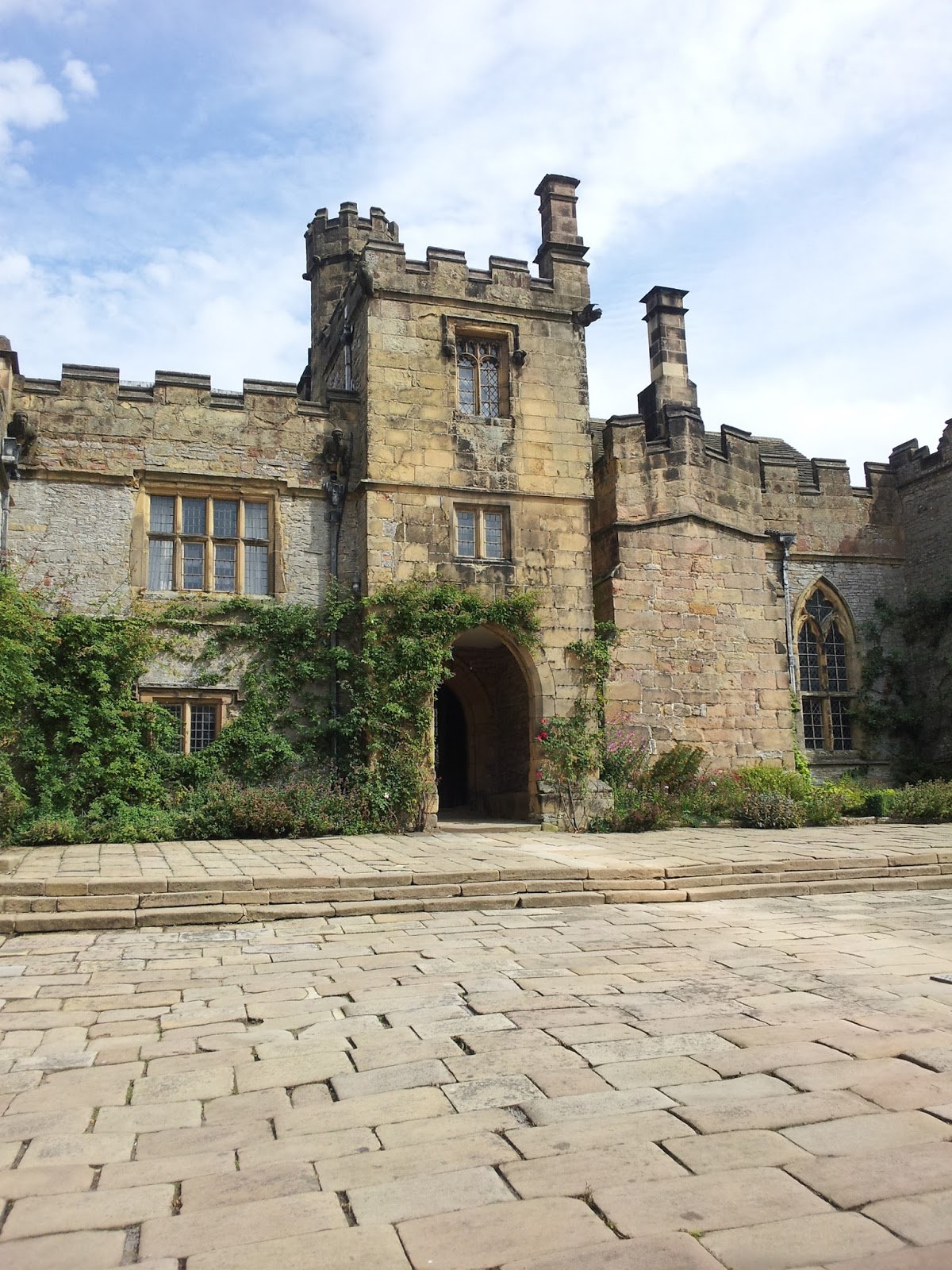

It was amazing. The place even smelled old, which probably sounds gross but really just added to the whole experience. 


But, I think it's very telling that there weren't any souvenirs of Orson Welles or Michael Fassbender as Mr. Rochester. There may have been some DVDs, but that's it. No one goes to bits over that character. I suppose he's a bit too dour for that sort of thing, plus there's the whole 'locking his first wife in the attic' debacle. Whereas Darcy may act all dark and serious, Rochester actually lives it. And it ain't pretty.

A little to the north, near the village of Hathersage, one can visit North Lees Hall, which was allegedly Charlotte Bronte's inspiration for Thornfield Hall in Jane Eyre and, as several area brochures made sure to mention, where Mrs. Rochester threw herself off the roof. First of all, spoiler alert? Secondly, what-- 'Home of Mr. Rochester' wasn't dramatic enough? Even the Peak District tourist board seems to adhere to the adage: "If it bleeds, it leads." Interestingly, Jane Eyre got her surname from a wealthy local family, and as is befitting a well-respected family, they now have several area pubs named after them. 

Hathersage is also home to Little John's grave, which made my earlier observation that the area reminded me of Robin Hood: Prince of Thieves slightly less embarrassing, and  
Stanage Edge, where you can recreate Keira Knightly's stance in the inferior non-Colin Firth version of Pride and Prejudice, as a twentysomething British guy helpfully informed me. Apparently he has a picture of himself doing the same pose. But, sadly on the day I traveled to Hathersage it poured for hours. I tried to wait it out but when the lone bus back to Eyam came, away I went. 


Thursday, June 6, 2013

Travel Inspiration #1: Brit Film & TV

I have spent an inordinate amount of my life watching British films and tv series, especially since Netflix was invented. Growing up I was mostly at the mercy of my local PBS station or A&E so I was thrilled to finally have unlimited access to shows other than Monty Python, As Time Goes By, Pride & Prejudice, and whoever was playing Ms. Marple. 

But, as much as I enjoy the intricate story lines and compelling characters, with each new viewing I became more and more drawn to the landscape and settings: the Peak District, Yorkshire, Lyme Park--pretty much anywhere in Wiltshire. (IMDB has been incredibly helpful in providing filming locations.) 

Though I studied abroad in London for a summer, my time spent outside the city was limited to a few day trips here and there. So when I started planning my trip I knew I wanted to visit these places. (This was further compounded by my desire to visit certain literary landmarks like Haworth, but more on that later) Basically, I want my summer to look like both versions of  Pride and Prejudice, this version of Wuthering Heights, and 1993's The Secret Garden:


Anything look familiar?

Monday, April 29, 2013

Springtime Rambling in The Farmington Valley and Beyond


Lately I've taken to going on hikes near my home as a way to escape from end of the semester stress. It's easy to forget how calming simply being in nature can be. I'm also lucky enough to live near a number of great hikes and now that the weather is better I plan on taking full advantage of my surroundings. Yesterday James and I checked out the trails that surround the Hill-Stead Museum in Farmington, CT.


It was  the perfect end to the weekend. I only wish I could get out more during the week. Soon.


I'm planning my summer travels and this has really inspired me to look into walking tours in the UK. I literally just want to wander around the countryside for a few weeks and recharge. 


I'm thinking of hitting up the Peak District to recreate Lizzy Bennet's journey to Pemberly and then checking out the Yorkshire Dales and recreating Heathcliff's crazed ramblings searching for Catherine's ghost.

Wednesday, April 25, 2012

Literary Eats: Apple Dumplings from Emma by Jane Austen

  -->


Jane Austen once wrote that of all her literary creations, Emma Woodhouse was the one most like herself.  Writing during England’s wild (at least for the British) Regency period, when King George III was too mad to rule and the Prince Regent was given the reigns, Austen infused her novels of life in the English countryside with humor, romance, and a keen look at the pressures of middle class women to marry for money. However, she is most remembered for creating Mr. Darcy, who usually assumes the form of a young Colin Firth in most imaginations. Well, at least in mine. Anyways, there is no Mr. Darcy in Emma. But, there is a Mr. Knightly, who is sort of like an older, less stuck up version of Mr. Darcy. Emma Woodhouse is rich, and unlike many of Austen’s other heroines, she doesn’t feel pressured to get married. Therefore, she spends most of her time trying to get other people married, with mixed results.

As with all Austen novels, the eccentric supporting characters are often more memorable (and well-developed) than the main players, and the world of Emma Woodhouse is no exception, from her hypochondriac father, to her well-meaning but dull best friend Harriet Smith.

It is through Miss Bates, the chatterbox spinster daughter of Mrs. Bates and aunt to the beautiful and mysterious Jane Fairfax, that we learn of not one but two apple dishes: Baked apples and apple dumplings. These are mentioned during the course of a mostly one-sided conversation commenced by Miss Bates while Emma is out shopping. Somehow the conversation (or rather, monologue) jumps from a rivet for Miss Bates’ glasses to apples:

[…] At one time Patty came to say she thought the kitchen chimney wanted sweeping. Oh, said I, Patty do not come with your bad news to me. Here is the rivet of your mistress's spectacles out. Then the baked apples came home, Mrs. Wallis sent them by her boy; they are extremely civil and obliging to us, the Wallises, always—I have heard some people say that Mrs. Wallis can be uncivil and give a very rude answer, but we have never known any thing but the greatest attention from them. And it cannot be for the value of our custom now, for what is our consumption of bread, you know? Only three of us.—besides dear Jane at present—and she really eats nothing—makes such a shocking breakfast, you would be quite frightened if you saw it. I dare not let my mother know how little she eats—so I say one thing and then I say another, and it passes off. But about the middle of the day she gets hungry, and there is nothing she likes so well as these baked apples, and they are extremely wholesome, for I took the opportunity the other day of asking Mr. Perry; I happened to meet him in the street. Not that I had any doubt before— I have so often heard Mr. Woodhouse recommend a baked apple. I believe it is the only way that Mr. Woodhouse thinks the fruit thoroughly wholesome. We have apple-dumplings, however, very often. Patty makes an excellent apple-dumpling. Well, Mrs. Weston, you have prevailed, I hope, and these ladies will oblige us."

Keep in mind that there’s a whole other paragraph I didn’t subject you to...

Anyways, it is unsurprising that Mr. Woodhouse, a man who seems to live almost exclusively on the diet of a fussy toddler, would believe that only a baked apple is a wholesome apple. However, I am more interested in Miss Bates’ apple dumplings. There’s just something so delicious about the word ‘dumpling’---perhaps because it invokes visions of something delicious wrapped in dough and fried, or in this case, boiled. Yes, apple dumplings are essentially cored and peeled Granny Smiths wrapped in pastry and then boiled. Oh and there’s sugar. Lots of it. 


In Hannah Glasse’s The Art of Cookery Made Plain and Easy first published in 1747, her recipe for apple dumplings requires them to be boiled for upwards of an hour, depending on the size:

“Make a good puff pastry, pare some large apples, cut them in quarters, and take out the cores very nicely; take a piece of the crust, and roll it round, enough for one apple; if they are big, they will not look pretty, so roll the crust round each apple, and make them round like a ball with a little flour in your hand; Have a pot of water boiling. Take a clean cloth, dip it in the water, and shake flour over it; tie each dumpling by itself, and put them in the water boiling, which keep boiling all the time; and if your crust is light and good, and the apples not too large, half an hour will boil them; but if the apples be large, they will take an hour’s boiling. When they are enough, take them up, and lay them in a dish; through fine sugar all over them, and send them to table. Have good fresh butter melted in a cup, and fine beaten sugar in a saucer.”

I was incredibly skeptical about this. I mean come on, boiled apples? How good could that possibly be? But, for the sake of this blog, I gave it a shot. The result? Surprising deliciousness! I used frozen puff pastry as a short cut. I then peeled, cored, and halved the apples. Next, I wrapped the halves in the puff pastry and tied them up in cheese cloth to keep them secure. I boiled the apples until soft, then tossed the dumplings in butter, sugar and cinnamon. They were like little doughy apple-filled pillows, though not as photogenic as baked apple dumplings. You win this round, Miss Bates.